
A Behavioral Model for Law Firm Leadership

What can lawyers expect from management, and what do those leaders have a right to expect from lawyers?
Leadership has long been a hot topic in law firms.
Any law firm can be an organization with designated, formal leaders. The most successful law firms, however, are evolving into organizations of leaders. In these firms, leadership effectiveness is based on the collective impact of what people say and do every day, i.e., a variety of specific, observable behaviors they choose to use in the work environment.
For example, in a law firm of leaders, everyone—from the most senior partner to the most junior clerk—is welcome and expected to ask questions, speak up, and initiate improvements - working together to solve problems and foster success. Expectations for these types of leadership behaviors communicate “We are in this together, we all have something to learn, and success is a group effort.”
How does a law firm with leaders become a law firm of leaders? The development of leadership—whether in individuals or in groups—starts with people knowing what is expected of them and how to do it. So colleagues ask questions like: “What does it mean to have shared leadership responsibilities? What can I contribute, and what can I look to you to contribute, commensurate with your job and skills? How and when will we talk with each other about these expectations of one another?
Partners can’t expect lawyers to be leaders if they don’t have safe opportunities to assume new responsibilities and practice their non-technical skills. Participating in or leading meetings and coaching or supervising others carries with it some risks. If people fear they will be reprimanded or misunderstood for being imperfect, asking questions, or proposing improvements, for example, they learn to avoid the risks and stay quiet.
Groups of partners will vary in how they prioritize and describe effective behaviors. Their leadership expectations are influenced by the culture of the firm and the needs of the situation. Often these expectations are assumed but not communicated.
What beliefs about effective leadership behaviors does your firm impart to lawyers and staff? Are there gaps between what partners say is important and what they actually reward or do?
For example, do partners say the firm wants everyone to value the wellbeing of lawyers yet they ask people to work long hours on a frequent basis, often without prior notice? Do they say they want everyone to support teamwork and then pit individuals against each other to compete for dwindling amounts of work? Do they say they want colleagues to raise concerns and then ignore or chastise them when they do?
Organizational leadership—the type that builds law firms of leaders—requires partners to decide which leadership behaviors they want to pay attention to and develop in themselves and others. They ask and answer: “What leadership behaviors from individuals and groups will help us succeed in this particular matter, goal, or firm initiative?” Then they communicate their expectations and help everyone, in keeping with their responsibilities, to learn and use the desired behaviors.
Beyond that, partners ask for feedback on their own leadership behaviors in order to reduce gaps between what they say is important and what they actually do as role models.
Partners don’t need to change their personalities to become better leaders. However, they may need to change or modify what they say and do if they expect to encourage leadership behaviors in others. Just saying we want shared accountability for success isn’t enough.
Choices that partners make about their behaviors directly affect how others work together and, in turn, whether others become effective leaders. Periodic speeches, edicts, and simplistic reactions to performance issues are not effective leadership behaviors.
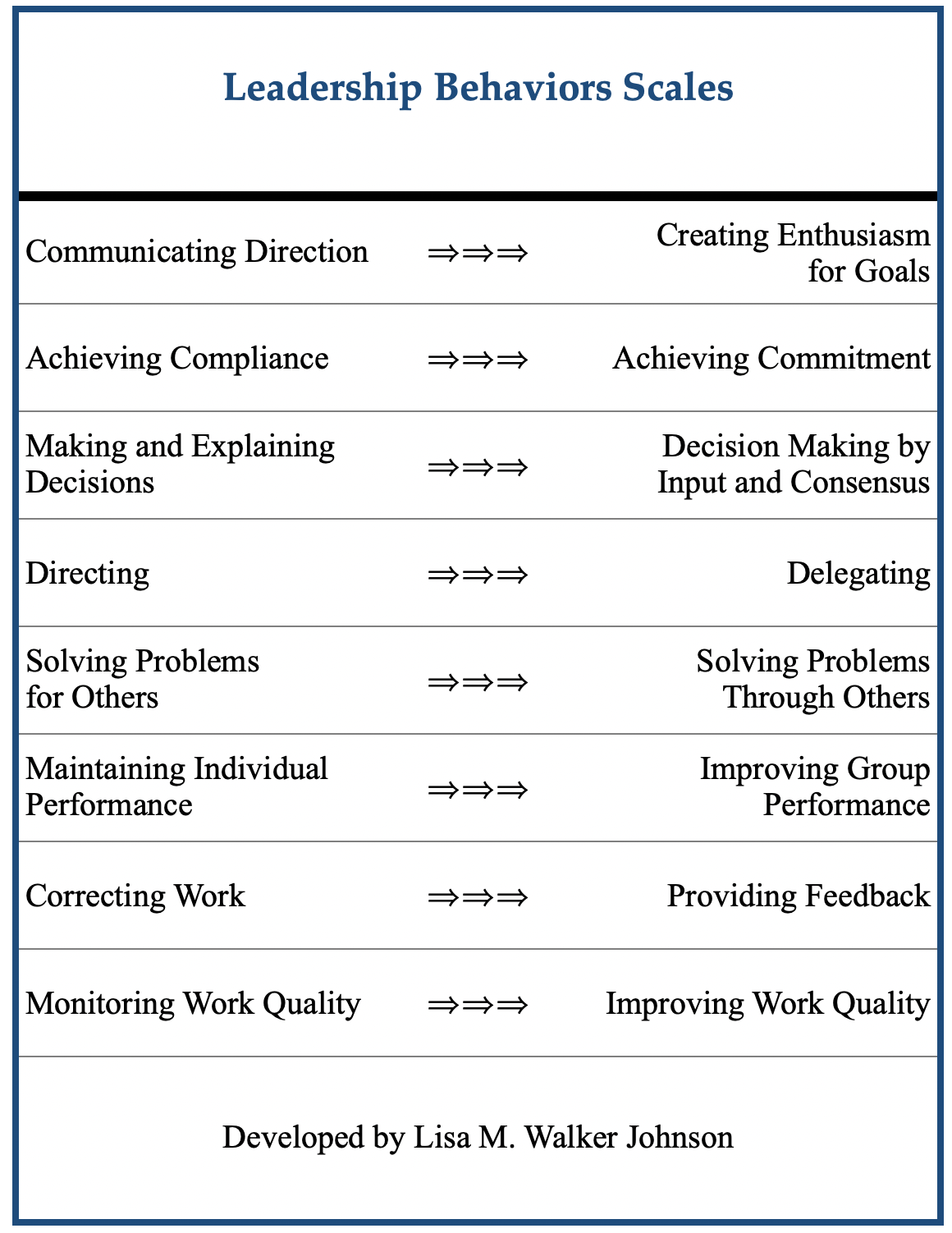
Eight leadership behavior scales
The behavioral model, above, illustrates a sample of leadership behaviors along eight scales. There could be many other continuums that are relevant in today’s law firms. There are no wrong answers or “healthy” or “unhealthy” positions in each scale. The practice environment and cultural context will, to some extent, determine each leader’s initial position. A helpful question for leaders to ask is: “Are we using the full range of possible leadership behaviors in our current roles, and are we likely to get the results we want using those behaviors?”
On the far left of each behavioral scale, we observe examples of more traditional law firm management behaviors where controls are tight, and individual autonomy is limited. Basically, people do as they are supposed to do based on direction from their supervisor. Sometimes these leadership behaviors are indeed appropriate.
When partners stay “stuck” using only the behaviors represented on the left side of the model, they risk micromanaging and limiting opportunities for professional growth and leadership development in others.
Supervisors and partners purposefully increase the frequency and quality of their behaviors, moving toward the right side of the model, when they want to reward initiative and accountability, stimulate critical thinking and problem-solving, and promote group effectiveness, i.e., develop leaders.
Leadership behaviors moving to the right side of the scale contribute to an environment where people demonstrate greater commitment, are more likely to coach and mentor others, and report less negative stress in their work environments.
From Communicating Direction to Creating Enthusiasm
When expectations are too clearly and specifically articulated, often in great detail and sometimes with little room for individual variation or discretion, people often report they feel like “cogs in a wheel.”
Moving toward the right side of the scale, leaders not only communicate directions clearly, but they also ensure that people understand how the task supports the larger aims of the firm. They give people affected by decisions opportunities for input, encouraging their thoughts and ideas, even feelings.
When people are involved, they are more likely to say they have a “line of sight” to where the firm wants to go and how they can help. They understand and can articulate how their work contributes to delivering a service or product to the client and how their efforts help the firm accomplish its goals. They are more likely to work with others over time to get results rather than becoming distracted and discouraged.
From Achieving Compliance to Achieving Commitment
All law firms have procedures and rules. Partners issue rules in order to assure that each person complies with firm policy. Managing partners may feel, for example, that they have succeeded when they get their partners to go along with a policy, such as submitting time entries or reviewing invoices promptly.
Simple compliance isn’t sustainable, though. Unless people understand each policy's importance to the firm’s overall success, attention wanes.
A lawyer becomes personally committed to prompt submission of time sheets, for example, because he or she understands that prompt submission of time sheets has a direct impact on the firm’s financial profitability, which hits their pockets too. Lawyers are more likely to act as leaders, coaching others to prioritize tasks and raising flags if the software isn’t user-friendly, for example, than if they are simply told to do something without any invitation for involvement.
From Making and Explaining Decisions to Decision Making by Input and Consensus
Traditionally, partners have preferred “top-down” decision making. They are, after all, the owners of the firm. They aspire to make decisions swiftly, expeditiously, and with no “wheel spinning” or protracted discussion. Time is money.
Feedback about the decision, either before or after it is made, may be considered second-guessing and is not sought or welcome. Questions from others can be viewed as challenges to authority or even acts of disloyalty.
Leaders who want more than compliance and who know they need a certain amount of buy-in and participation, even from non-owners, to implement their decisions, start moving their behaviors to the right side of this scale.
This is not just a charade to prevent dissension. These decision makers encourage and even reward dissent, because it tests and strengthens the decision-making process and the overall quality of the decision itself. They seek buy-in before the decision is made, not just agreement after it is announced.
These leaders can act decisively when they need to, announcing and explaining decisions. However, they usually prefer to take a more intentional approach to planning and implementing important decisions. They tend to gather evidence, consult with others, test alternatives, and plan goals before jumping into reactive solutions.
From Directing to Delegating
Sometimes leaders give work to others with very specific expectations and narrow limits on individual discretion or judgment. Delegation, if it occurs, is tightly controlled and closely supervised.
Partners moving to the right side of the scale think about the differences in the quality of legal work that is required. They choose appropriate leadership behaviors based on that work and the development needs of individuals and groups, rather than just defaulting to “It’s easier and faster if I just tell you exactly what to do.” They gradually increase the discretion and independence that associates and assistants need to be responsible and accountable for the work they perform.
Associates and assistants may perform relatively sophisticated, important legal work under the evolving guidance of a partner, thereby gaining skills and experience years before their counterparts in other firms. This experience provides a platform to undertake even more challenging assignments.
Some delegated work tends to be routine, low-risk, and uncomplicated. This work is often misdelegated. For example, associates are assigned work that could be performed equally well by paralegals or other non-lawyer personnel.
As leaders move to the right side of the scale, they are thinking about how to integrate delegation skills into professional development and mentoring—for organizational impact, not just to complete a task.
From Solving Problems for Others to Solving Problems With Others
One of the major duties of law firm partners and administrators is to solve problems. On the far left of the scale, partners tell others, “Rather than attempting to solve a problem yourself—and risk making the situation worse—refer it to me and I’ll tell you what to do, or I’ll take care of it myself.”
This level of control, while solving an immediate problem, does not create a platform of knowledge and skills that help build leadership skills in others. Future problem-solving still depends on the partner.
Moving along the scale to the right, partners decide to take a more situational approach to working with others to solve problems.
They may tell people, “We expect you to take the initiative to define, analyze, and gather facts about these types of problems, as well as to develop proposed solutions if you can. Then we will discuss next steps.”
Partners guide the problem-solving process, taking into account people’s unique abilities and the associated risks. Every situation becomes an opportunity to reinforce ethical considerations, address unique client factors, and improve efficiency. By providing information and resources and teaching others the skills they need to apply within their respective areas of expertise, partners grow the firm’s leadership exponentially.
Leaders acknowledge that, in most cases, those who work with a process every day are usually the best qualified to solve problems that arise. Rather than referring every problem up the chain of command, people have well-defined, clearly communicated areas of responsibility, authority, and accountability to solve problems as they arise. Permitted to solve their own problems, people develop problem-solving skills and self-confidence that enable them to be even more effective troubleshooters and team-oriented problem solvers in the future.
From Maintaining Individual Performance to Improving Group Performance
Well-managed firms invest substantial resources in keeping individual performance up to prescribed standards. If performance falters, personal deficiencies are almost always the first line of inquiry. Hence, leaders operating at the far left of the scale may not even consider performance outcomes from anything other than a personalized lens.
In contrast, leaders operating more to the right still pay attention to, and invest heavily in, individual performance; but they also focus on the environment in which people work. They consult with others to identify obstacles to individual and group performance that can range from cross-functional systems and processes to resource constraints and outdated policies. They prioritize asking questions and learning from one another to improve the work environment in ways that enhance performance, mitigate stress, and benefit everyone.
Leaders moving to the right of the scale also understand that a high-performance group is more than just the sum of its parts. They continually seek new ways for people to combine their individual talents and leadership expertise. They pay attention to group development and to the leadership behaviors that are best suited to what groups need at a given point in time.
Cross-selling in firms is one area that requires leadership behaviors toward the right side of this scale. Behaviors on the left, where lawyers are inclined to work in silos, make it harder to implement cross-marketing successfully and sustain it for more than a few months. When leaders are already operating more to the right-hand side of the scale, they are successful at cross-marketing because their information, resources, and skill sets already emphasize group performance. They know each other and know how to position even their complex services for sophisticated clients.
From Correcting Work to Providing Feedback
Partners necessarily correct the work of associates and assistants. For example, they may provide marked-up copies of documents, ideally so that the less-experienced lawyers can learn from their mistakes.
However, at a certain point in a lawyer’s development, a supervising lawyer will want to see that lawyers are able to spot and correct their own mistakes before sending them up for review. Leaders will use behaviors more to the right side of this scale to encourage greater ownership and higher quality results.
One way they do this is by providing ongoing feedback at frequent, regular intervals to clarify expectations, challenge lawyers' critical thinking in their areas of expertise, and guide them toward a deeper understanding of client expectations and matters.
The goal of these feedback sessions is to plan performance improvements, not just to conduct a postmortem on past mistakes. Leaders also use praise, a feedback tool that is less often used on the left side of the scale. The goal is to keep people doing what they already do well and to improve future performance.
From Monitoring Work Quality to Improving Work Quality
Measurement is a hallmark of the well-managed law firm. At the left end of the scale, most leaders focus on monitoring performance metrics such as error rate, reasons for write-offs of time, and processing times.
Lacking an understanding of statistical process control and variation, partners also tend to overreact to relatively minor, short-term variations in performance. At best, they impose short-term solutions with little or no input from the people who actually do the work. As a result, they are constantly chasing the numbers with no meaningful results.
Chasing the numbers can be a deadly sport for any business. Quick fixes are tempting, especially when the firm has not shown consistent profitability or steady cash flow. Quick fixes in response to short-term fluctuations in financial performance can provide short-term benefits. However, quality management research shows that such reactions–also known as tampering–will usually make things worse in the long term, either by making the process even more unpredictable or by producing unexpected problems in other areas.
Leaders operating toward the right side of the scale use performance measurements to diagnose and address defective work processes. Rather than merely monitoring quality, these leaders are engaged in the continuous improvement of every critical internal work process. They understand the principles of variation and use them to spot problems before they become crises. Quality improvement is very much a bottom-up initiative, encouraged and rewarded by senior leaders rather than dictated by them.
Using the behavioral model to build leadership one person at a time
Diagnosing the leadership state of a law firm
Honest diagnosis is a critical first step toward building leadership in organizations. All the leadership theory in the world will have little effect if a law firm does not take a frank look at behaviors (what leaders say and do) and their impact on people’s ability to deliver quality services and products to their clients.
Setting priorities for leadership development
Law firms today find that, to compete, they need to develop leaders in all areas of their organizations. To do this, they need to be aware of the range of choices they have and then select leadership behaviors that are likely to get the best results. The eight scales in the behavioral model can be a source of feedback to partners about where they are spending most of their time as leaders, i.e., more to the left or more to the right?
The scales can also help partners spot development priorities based on what the firm wants to achieve. For example, if firms want to increase commitment, reward initiative and accountability, stimulate critical thinking and problem-solving, and promote group effectiveness, the partners will want to find ways to more frequently use behaviors moving toward the right of these scales.
However, this does not mean that a firm should repudiate sound management practices and principles that are more characteristic of the left side of each scale. In times of crisis or when there are significant changes to performance expectations, for example, people may need more direction, assurance and risk management controls in place. Instead, partners will want to be intentional in their leadership behavior choices, expanding autonomy and participation to individuals and groups, as appropriate, to continue to develop leadership capabilities throughout the firm.
A leadership transformation
To transform an organization, one must first transform individuals. The behavioral model works well for whole law firms, practice groups, and individuals. It identifies behaviors and habits that can obstruct the acquisition of a sense of ownership and skills, as well as those that will support leadership development.
Many of us still seek leadership gurus. We long for checklist solutions to the age-old riddle of how to motivate highly individualistic professionals to reach their potential as a team. The most practical solutions—the ones that produce the best, longest-lasting results—may well be found by looking inward at how we practice our profession and do our work every day. This behavioral model for law firm leadership is one tool that can help us identify the options and solutions already within us, prompting us to choose.
Copyright 2014, 2026, Walker Clark LLC. Visitors to the Walker Clark website may reproduce and distribute this article within their organizations, provided that its contents are not changed and that full and exclusive authorship and ownership rights are clearly attributed.